Bruno Latour
-

French Philosophy Today paperback now shipping
I just received my copy of French Philosophy Today in paperback. You can find it on Amazon here. Alain Badiou, Quentin Meillassoux, Catherine Malabou, Michel Serres and Bruno Latour: this comparative, critical analysis shows the promises and perils of new French philosophy’s reformulation of the idea of the human. See here for chapter summaries.
-
French Philosophy Today paperback now on Amazon pre-order
I am delighted to announce that the paperback edition of French Philosophy Today is now (finally!) available for pre-order on Amazon. The U.S. site has it at $39.95 and most European sites set the price at around €25. Curiously, amazon.co.uk has the paperback at £150, which I assume is a mistake soon to be corrected. Here is
-
French Philosophy Today to join Difficult Atheism on Edinburgh Scholarship Online
I’ve just learned that French Philosophy Today will shortly join Difficult Atheism on Edinburgh Scholarship Online. This, I hope, will come as good news to at least some of those who have been in touch with me about the price of the hardback edition.
-
French Philosophy Today reviewed at NDPR
French Philosophy Today has just been reviewed over at Notre Dame Philosophical Reviews. Here are some highlights: Gilles Deleuze and Félix Guattari’s famously defined philosophical production as concept creation. If they are correct, then Watkin’s work is not just a scholarly commentary of philosophy but also itself an inventive philosophical work. If Alain Badiou, the
-
French Philosophy Today: Summary of Chapter 6 – Bruno Latour
This is the sixth in a series of posts providing short summaries of the chapters in my latest book, French Philosophy Today: New Figures of the Human in Badiou, Meillassoux, Malabou, Serres and Latour. For further chapter summaries, please see here. Chapter 6 considers the figure of the human that emerges in Bruno Latour’s An Inquiry into Modes
-
In this Sunday’s Age and Sydney Morning Herald I’m quoted talking about robots, consciousness and Descartes
With the publication of my book on contemporary limits and transformations of humanity coming out next month I had the chance this week to talk with John Elder of The Sunday Age about the future possibility of rights for robots. John’s article came out today in The Sunday Age and the Sydney Morning Herald, with the title “What happens
-
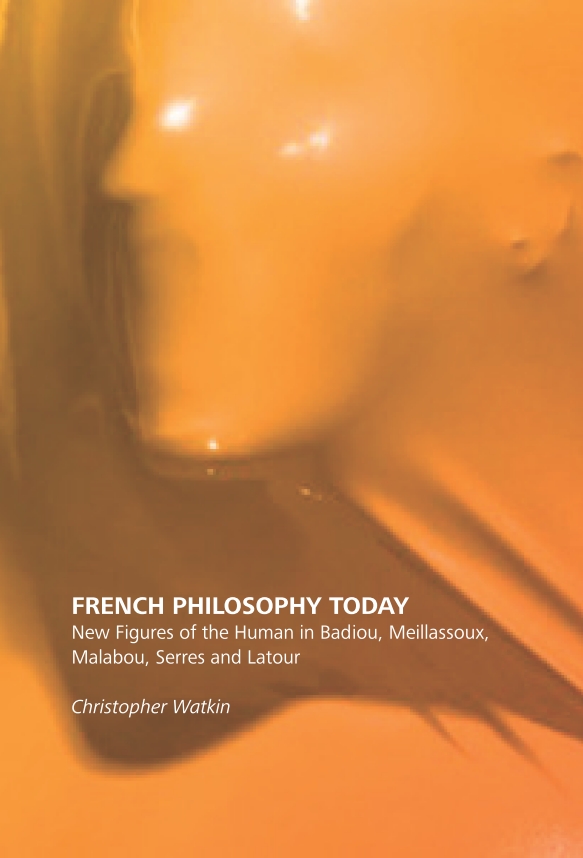
French Philosophy Today: New figures of the Human, low-res cover
Today I received the first low resolution mock-up of the cover for my new book: French Philosophy Today. New Figures of the Human in Badiou, Meillassoux, Malabou, Serres and Latour. Many thanks to Rebecca Mackenzie and Julien Palast for your wonderful work.
-
Bookending the crisis of modernity: Latour is finishing what Nietzsche mistakenly started
I’m currently writing the final chapter of The Human Remains, addressing Bruno Latour’s modes of existence project and work on Gaia in relation to Serres, Malabou, Meillassoux and Badiou’s accounts of the human. It’s all hands to the pump and there is little time to expatiate on this blog, but I couldn’t resist quickly drawing attention to
-
A table showing who is part of the new materialism, and an argument as to why it is not a “turn”
I’m currently writing the introduction to The Human Remains, discussing the figure of the human in the new materialism. I thought I would share the table I drew up of all the thinkers identified as part of the new materialism in different monographs and collected volumes. I have excluded individual journal articles from the list
-
Brief comparative remarks on love in Bruno Latour’s Jubiler and Jean-Luc Nancy’s L’Adoration
In Jubiler ou les tourments de la parole religieuse (Rejoice, or the Torments of Religious Speech), Latour’s attempt to re-think religious discourse in the face of the double-click fantasy is drawn out of a consideration of lovers’ discourse, and it bears an interesting resemblance to Jean-Luc Nancy’s treatment of love in L’Adoration. Both texts
-
Bruno Latour, Jubiler, ou les tourments de la parole religieuse (Rejoicing: Or the Torments of Religious Speech) #1
Bruno Latour’s Jubiler, ou les tourments de la parole religieuse (Les empêcheurs de penser en rond, 2002) is set to come out this year in English wish Polity Press as Rejoicing: Or the Torments of Religious Speech. Though Latour claims that the book exhibits a rigorously scientific approach, it certainly reads as something of a complex
-
Modernism: Objects and quasi-objects in Woolf’s To the Lighthouse
This is the second in a series of two posts about the ‘subject’ and ‘objects’ of Woolf’s To the Lighthouse, in relaiton to the literary studies unit on modernism I will be teaching this coming semester. Literary criticism, in step with Cartesian dualism, has tended to operate according to a dichotomy of active subjects and