Uncategorized
-
Two upcoming book launch events
The stories we assume about human origins profoundly shape our modern assumptions about freedom and equality, our relationship to each other and the natural world.Unpacking these philosophical origin stories isn’t just an exercise in history; it gives us a remarkably powerful lens for understanding the complex forces driving our contemporary political and cultural landscape.If you’re
-

Spaced Repetition and AI: A Data-Driven Approach to Vocabulary Learning
Language learners often face a familiar frustration: memorising vocabulary feels easy in the moment, but the words quickly fade from memory. Traditional vocabulary lists and last-minute revision rarely lead to long-term retention. To address this problem, I recently developed a vocabulary learning aid designed to help students organise and review the words they are learning
-
Video: Panel on Biblical Critical Theory at ETS Conference
This panel, held to explore themes raised in my book Biblical Critical Theory, was held at the 2023 conference of the Evangelical Theological Society in San Antonio, Texas. Moderator: Dr. Jennifer Powell McNutt (Wheaton College) Panelists: Dr. Kristen Deede Johnson (Western Theological Seminary) Dr. Malcolm Foley (Baylor University) Dr. Greg Forster (Trinity Evangelical Divinity School)
-

Guest post: For Woman, Life, Freedom
This is a guest post by Alma Fazeli, a PhD candidate whom I have the pleasure of supervising. In the post Alma reflects on the events taking place in her homeland of Iran at the moment. The thoughts, words and sentiments are Alma’s, and I am very happy to be providing a vehicle for her
-

Christianity and the social contract: preliminary reflections
The paper below was prepared for the Jubilee Centre taskforce on the role of the state in the post COVID-19 world. Its intention is to provide a brief overview of classic social contract theory and then identify some ways in which the social contract paradigm relates to Christian theology. Enjoy! Christianity and the social contract
-
An experimental video lecture on Beckett’s Krapp’s Last Tape
Can students really not concentrate for 50 minutes any more? Is constant interactivity really the only way to hold attention today? Might it be that resisting the commodotisation and commercialisation of attention requires modes of resistance that are deeper than simply cutting with the grain of addictive modes of engagement? It was in part in
-

Helping university students to approach language learning as a way of life, not a slot on the timetable
Mastering a language is not like learning any other Arts faculty subject: to learn a language is to immerse oneself in a way of experiencing and engaging with the world, not to assimilate a body of knowledge or even a methodology. Language and culture are the means through which we experience anything at all, not
-

A quick note to my subscribers
Hi! I’ll make this as quick as I can; I know you’re busy… First of all, thanks for following my updates! I hope you find the topics interesting and I’m always open to feedback. Over the past week I’ve migrated christopherwatkin.com from WordPress.com to WordPress.org. I’m excited about the possibilities this opens up for
-
Marcel Gauchet in discussion in Melbourne: The Crisis of Democratic Politics
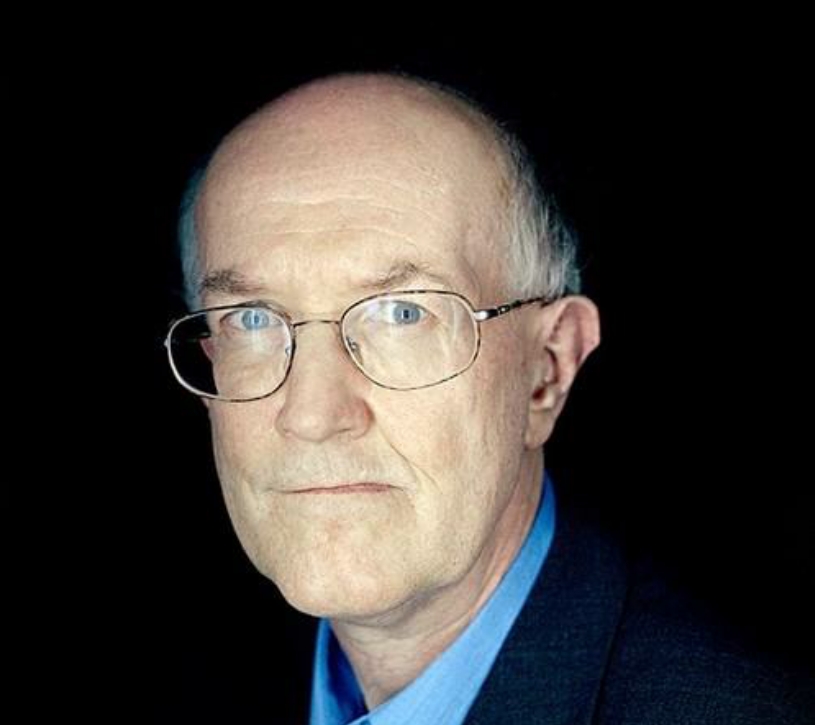
Here is news of an exceptional event in Melbourne, with Marcel Gauchet on democracy, crisis, and–no doubt–Trump: 27 th January 2017, Time: 6.30 pm. RMIT University, City Campus School of Business and Law lecture theatre Building 13 Level 3 Room 9 Address: 379-405 Russell St, Melbourne. Map Event blurb: This event is part of the French Festival
-
The Return of Religion, Kettle Logic, and the Secular Dilemma
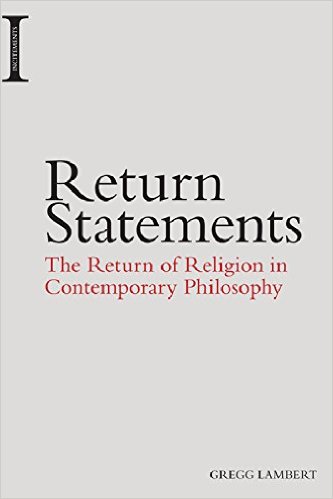
At this year’s Australasian Society of Continental Philosophy conference I had the pleasure of responding to Gregg Lambert’s new book Return Statements: The Return of Religion in Contemporary Philosophy. I chose to focus on the very idea of the “return of religion”, its multiple senses, and their potential conflicts. The paper is downloadable from academia.edu and
-
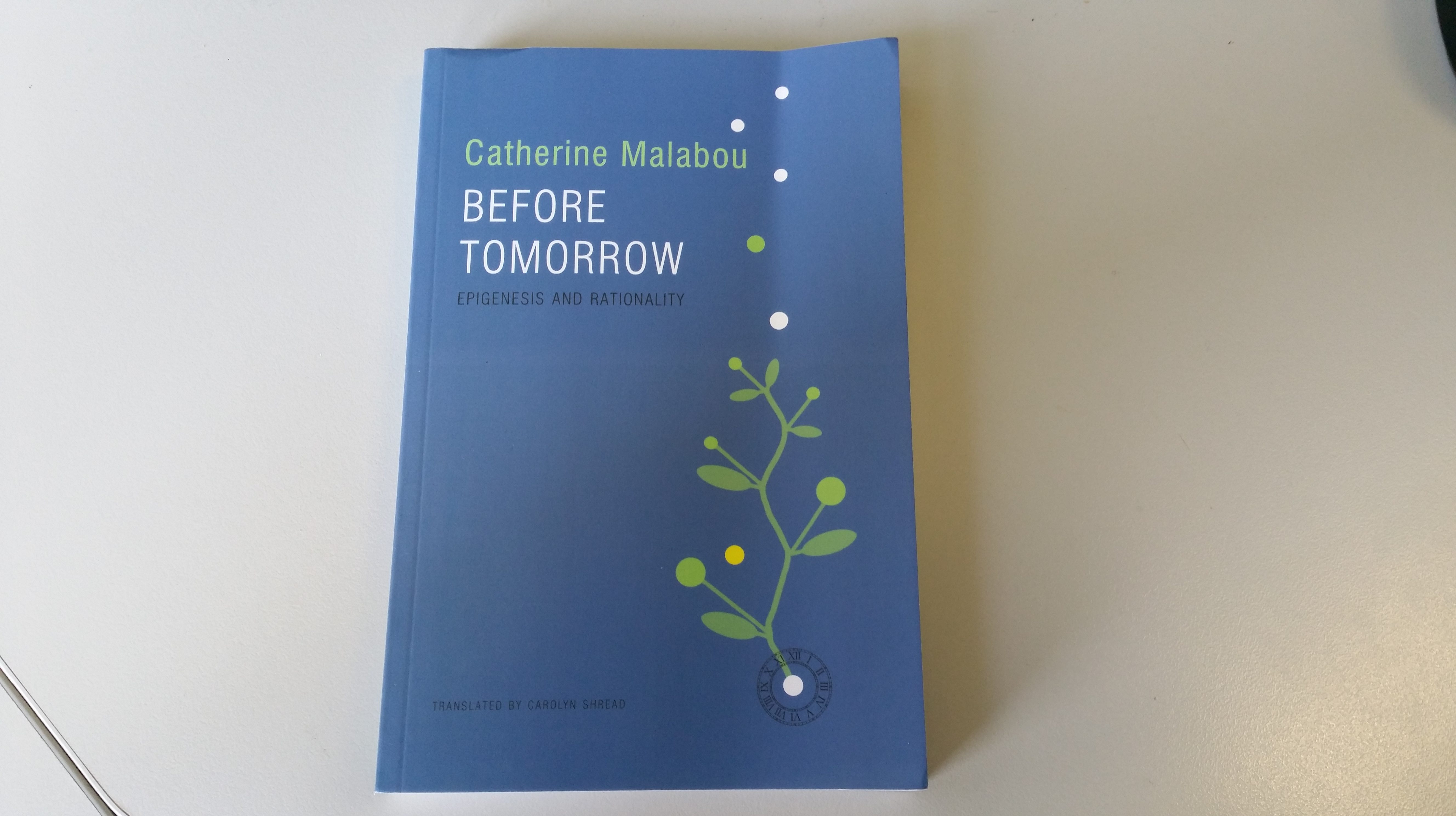
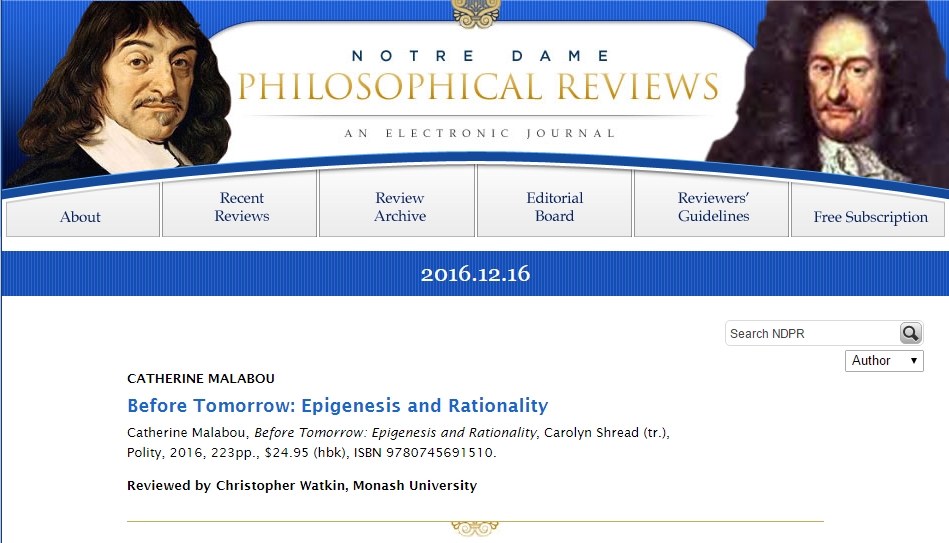
Just received: Malabou’s Before Tomorrow to review for NDPR
Pleasant surprise waiting for me at work this morning: Catherine Malabou’s Before Tomorrow to review for @NDPReviews. I worked with the French for the two chapters on Malabou in French Philosophy Today, and I’m looking forward to the translation.
-
French Philosophy Today to join Difficult Atheism on Edinburgh Scholarship Online
I’ve just learned that French Philosophy Today will shortly join Difficult Atheism on Edinburgh Scholarship Online. This, I hope, will come as good news to at least some of those who have been in touch with me about the price of the hardback edition.
-
Difficult Atheism reviewed in Derrida Today
The latest issue of Derrida Today includes a review of my Difficult Atheism by Christina Smerick. You can read the whole review online for free here. Watkin’s thesis is bold and unapologetic, and shapes the path of his reading and thinking with intense focus. His main concern, bordering on a battle cry, is that the ground gained by atheism
-
French Philosophy Today reviewed at NDPR
French Philosophy Today has just been reviewed over at Notre Dame Philosophical Reviews. Here are some highlights: Gilles Deleuze and Félix Guattari’s famously defined philosophical production as concept creation. If they are correct, then Watkin’s work is not just a scholarly commentary of philosophy but also itself an inventive philosophical work. If Alain Badiou, the
-
French Philosophy Today: Summary of Chapter 6 – Bruno Latour
This is the sixth in a series of posts providing short summaries of the chapters in my latest book, French Philosophy Today: New Figures of the Human in Badiou, Meillassoux, Malabou, Serres and Latour. For further chapter summaries, please see here. Chapter 6 considers the figure of the human that emerges in Bruno Latour’s An Inquiry into Modes
-
French Philosophy Today: Summary of Chapter 5 – Michel Serres
This is the fifth in a series of posts providing short summaries of the chapters in my latest book, French Philosophy Today: New Figures of the Human in Badiou, Meillassoux, Malabou, Serres and Latour. For further chapter summaries, please see here. With Michel Serres’s universal humanism (Chapter 5) the argument returns to the question of host capacities in
-
French Philosophy Today: Summary of Chapter 4 – Malabou, The Epigenetic Human
This is the fourth in a series of posts providing short summaries of the chapters in my latest book, French Philosophy Today: New Figures of the Human in Badiou, Meillassoux, Malabou, Serres and Latour. For further chapter summaries, please see here. Chapter 4 turns to the question of human identity over time in Malabou. After setting out the
-
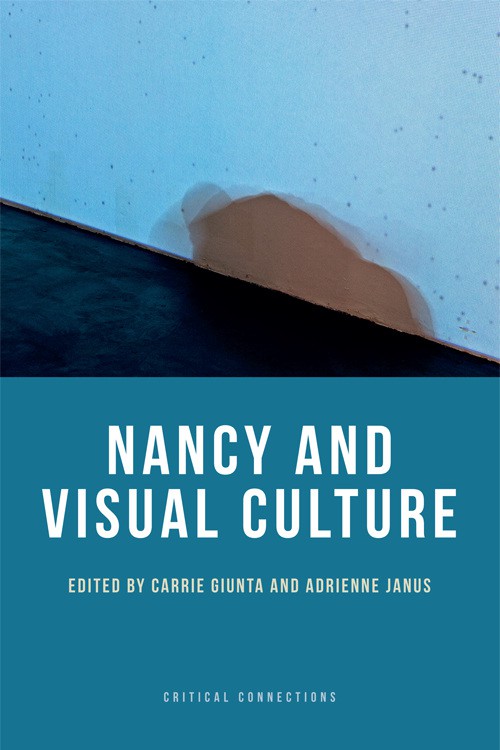
Jean-Luc Nancy and Visual Culture just published, with my chapter on Nancy, dance and equality
Just published: Nancy and Visual Culture. Here is the abstract for my chapter, entitled “Dancing Equality: Image, Imitation and Participation”. ‘We are facing a very new demand in terms of art’ remarks Nancy in Allitérations, ‘the demand that art be “made by everyone”’. And yet we also know very well that the arts require individuality, singularity
-
French Philosophy Today: Summary of Chapter 3 – Malabou, The Plastic Human
This is the third in a series of posts providing short summaries of the chapters in my latest book, French Philosophy Today: New Figures of the Human in Badiou, Meillassoux, Malabou, Serres and Latour. For further chapter summaries, please see here. The transition from Badiou and Meillassoux to Malabou leads us away from a host capacity
-
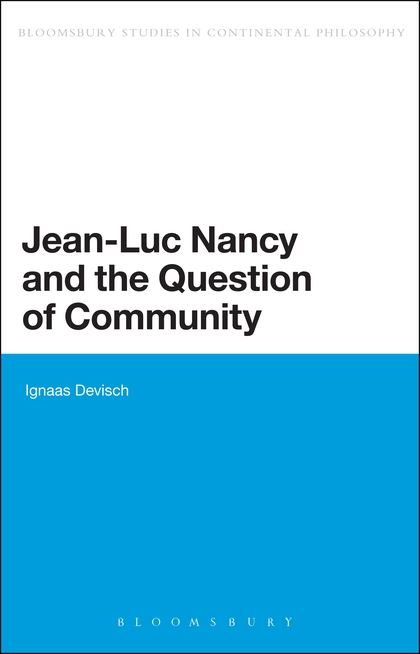
My review of Ignaas Devisch’s Jean-Luc Nancy and the Question of Community now available on the H-France website
My extended review of Ignaas Devisch’s excellent Jean-Luc Nancy and the Question of Community has just been published on the H-France website. The PDF can be downloaded here.
-
Talk in Melbourne on Aug 5 – Varieties of Contemporary Atheism: Badiou, Nancy, Meillassoux
On August 5 at 11am I will have the pleasure of speaking at the Melbourne University of Divinity philosophy seminar on the subject “Varieties of Contemporary Atheism: Badiou, Nancy, Meillassoux”. The talk seeks to synthesise and develop some of the main lines of thinking from Difficult Atheism and to open the argument of the book to
-
French Philosophy Today: Summary of Chapter 2 – Meillassoux
This is the second in a series of posts providing short summaries of the chapters in my latest book, French Philosophy Today: New Figures of the Human in Badiou, Meillassoux, Malabou, Serres and Latour. For further chapter summaries, please see here. Chapter 2 continues exploring the contemporary permutations of the host capacity account of humanity
-
French Philosophy Today: Summary of Chapter 1 – Badiou
Over the coming days I will be posting brief summaries of the argument of French Philosophy Today: New Figures of the Human in Badiou, Meillassoux, Malabou, Serres and Latour, chapter by chapter. Here is the main argument of Chapter 1, on Badiou. This first chapter probes the limits of Badiou’s “formalised inhumanism”. It argues that it
-
In this Sunday’s Age and Sydney Morning Herald I’m quoted talking about robots, consciousness and Descartes
With the publication of my book on contemporary limits and transformations of humanity coming out next month I had the chance this week to talk with John Elder of The Sunday Age about the future possibility of rights for robots. John’s article came out today in The Sunday Age and the Sydney Morning Herald, with the title “What happens
-
Michel Serres’s The Parasite: A Reader’s Guide. 148 page document to download
Over the past few weeks I have been working my way through Michel Serres’s 1980 Le Parasite: a dense, poetic, brilliant text that seeks to tear down and rebuild the way we think about everything. In reading the book I kept a running list of intertexts to which Serres refers, a document that runs to some
-
Third Derrida Podcast: Derrida, Atheism and Theology
The third of the podcasts on Derrida and Reformed theology has now been released. The first considered questions of metaphysics and the second focused on Derrida’s ethics; this final podcast discusses Derrida’s engagement with theological themes. I begin by discussing Derrida’s cautious affirmation that “I rightly pass for an atheist”, and try to dismantle the myth that, for
-
Second in the Derrida and Reformed Theology Podcast series: Derrida’s Ethics
In this episode I talk very briefly about the growing willingness to accept, from the mid 1990s onwards, that deconstruction is indeed ethical, before tackling the myth that Derrida is a relativist. I unpack the phrase “tout autre est tout autre” (“every other is wholly other”) from Derrida’s reading of Kierkegaard on Genesis 22 and
-
Cover proofs of French Philosophy Today, and endorsement by Clayton Crockett
Here are the newly minted cover proofs for French Philosophy Today, with the blurb and an endorsement by Clayton Crockett: ‘In this important book Christopher Watkin shows us the transformations of the human in the work of five contemporary philosophers who exceed the limits of post-structuralism. His treatments of Badiou, Meillassoux, Malabou, Serres and Latour
-
A diagrammatic snapshot of French philosophy from Magazine Littéraire, September 1977
Today I was given a copy of this edition of the Magazine Littéraire from September 1977 (thank you Philip). Its centrefold is a diagram seeking to represent flows of influence between contemporary philosophers. The table provides a fascinating snapshot… Marx is top and centre, flanked by Freud and Nietzsche. Influences are split between the two poles of
-
French Philosophy Today: New figures of the Human, low-res cover
Today I received the first low resolution mock-up of the cover for my new book: French Philosophy Today. New Figures of the Human in Badiou, Meillassoux, Malabou, Serres and Latour. Many thanks to Rebecca Mackenzie and Julien Palast for your wonderful work.
-
Interviews with two Monash colleagues: Poet and novelist Ali Alizadeh, and linguistician Alice Gaby
As part of a new role helping develop and foster research in the School of Languages, Literatures, Cultures and Linguistics (LLCL) at Monash, I am conducting an occasional series of interviews with colleagues about how their current research projects fit into the bigger picture of the questions and themes that run through their work. The
-
My article on Michel Serres, Biosemiotics and the “Great Story” of the Universe published in SubStance
My article “Michel Serres’ Great Story: From Biosemiotics to Econarratology” has just been published in SubStance. It is available from institutions with a subscription to Project Muse here. Abstract: In four key but as yet untranslated texts from 2001-2009, Michel Serres builds on his earlier biosemiotics with an econarratology he calls the ‘Great Story’ (Grand
-
Modernism Unit: Alain Badiou on Krapp’s Last Tape and “the space that lies between French and English”
To accompany the lecture on Beckett in the modernism unit, here is a lecture by Alain Badiou on Krapp’s Last Tape, in which he also reflects on “the space that lies between French and English”, a space he describes as “a perpetual torment”. He provides a commentary not only upon the play, but also on the negotiation
-
Rethinking alterity and logocentrism after phenomenology with Serres’s L’Hermaphrodite: Sarrasine sculpteur (1987)
This post is part of the series of draft entries for a Michel Serres dictionary. Abbreviations: Conv: Serres and Latour, Conversations on Culture, Science and Time TI: Serres, Le Tiers instruit One of Serres’s three book-length engagements with literary authors, l’Hermaphrodite was written significantly later than Jouvences (1974, on Jules Verne) and Feux et signaux
-
Women and Surrealism, by Chris Worth
This is a guest post by Dr. Chris Worth. One of the topics raised in the question time after Benjamin Andréo’s first lecture on Dada and Surrealism was a really good one about whether, despite their avant-garde aspirations, many of the key figures in the movements continued to take a very male-oriented to art and
-
Draft entry for a Michel Serres Dictionary: Le Système de Leibniz et ses modèles mathématiques (1968)
Le Système de Leibniz was published during the heady anni mirabiles of late 1960s French thought. It appeared in 1968, the same year as Roland Barthes’s short essay ‘The Death of the Author’, one year after Derrida’s Of Grammatology and Deleuze’s Difference and Repetition, and two years after Foucault’s The Order of Things. Like Derrida’s and
-
New Accumulator Test for Excel-based Vocabulary Learning Tool
I have added a new “Accumulator” test to Vocab Book, the Excel-based vocabulary learning tool I wrote last year. The new test simulates a tried and tested learning method: Imagine a vocab book in two columns with English words or phrases on the left and their target language translations on the right. At school I used
-
Michel Serres app now available on Google Play
I’ve written a little app to aggregate information from around the web (news, Twitter, Youtube, Google Scholar, Google Trends…) on Michel Serres. It’s nothing flash but it allows me quickly to scan various sources to see if there’s anything new on Serres, without having manually to visit plural URLs. It is free to download from
-
Michel Serres Today
Abstract. This is an expanded version of a paper originally given at the English and Theatre Studies research seminar at Melbourne University in May 2015, and it retains its oral tone. My intention both for the original paper and for this expanded version is to provide a first introduction to the work and thought of
-
Translation from Michel Serres’s thesis on Leibniz: “we must enrich our models of thinking which are, generally speaking, lamentably poor”
At the moment I am working my way through Michel Serres’s monumental Le Système de Leibniz et ses modèles mathématiques. I am struck by how many of the ideas that have come to be thought of as characteristically Serresian are already present implicitly or (more often than not) explicitly in this 800 page doctoral thesis. If it
-
Michel Serres Today: new paper uploaded to academia.edu
I have just uploaded a paper on Michel Serres to academia.edu. Here is the abstract: This is an expanded version of a paper originally given at the English and Theatre Studies research seminar at Melbourne University in May 2015, and it retains its oral tone. My intention both for the original paper and for this
-
Michel Serres: “There are two kinds of philosopher: there are philosophers who shackle you and philosophers who free you”
Peter Hallward: Heidegger’s works on language, and on being-with, did they have any value for you? Michel Serres: I was so busy with sciences and techniques that it was very difficult to throw myself into an author who refused them wholesale. There are two kinds of philosopher: there are philosophers who shackle you and philosophers
-
Consolidated list of all the Michel Serres primary bibliography posts
All the categories for the comprehensive Michel Serres primary bibliography are now up and running. I will keep adding titles over the coming months as I come across them, but in order to make the bibliography easier to navigate I have gathered below links to all the sections, as well as to the entire bibliography.
-
Towards a Comprehensive Michel Serres primary bibliography (7): newspaper and magazine articles
(1974). “Michel Serres et Jules Verne.” Le Monde, 10 May. http://www.lemonde.fr/idees/article/2011/03/05/eduquer-au-xxie-siecle_1488298_3232.html. Last accessed April 2015. (1979). “Le culte du ballon ovale.” Le Monde, 5 March. (1980). “Une présentation de la Nouvelle Alliance Commencements.” Le Monde, 4 January. (1982). “Un entretien avec Michel Serres: A quoi sert la philosophie?” Le Nouvel Observateur, 6 February, 82. (1982).
-
Video and image timeline of Michel Serres’ life and monograph publications
Timeline as jpeg (click on the image to open it on a page of its own, then click on it again to magnify. Use your browser’s scrollbar to move left and right across it): Timeline as a scrolling video:
-
Towards a Comprehensive Michel Serres primary bibliography (6b): audio and video (with embedded video)
This instalment of the bibliography lists Serres’ film and television appearances, as well as those videos freely available on the web in which he features (see all the Serres bibliography posts together on this page). This is the second version of this section of the bibliography. In this version, videos from Youtube, Dailymotion and Vimeo