Uncategorized
-
Towards a Comprehensive Michel Serres primary bibliography (6a): audio and video (with links)
This part of the bibliography lists Serres’ film and television appearances, as well as those videos freely available on the web in which he features (see all the Serres bibliography posts together on this page). This is the first of two versions of this section of the bibliography. On the other version, Youtube, Dailymotion and
-
Towards a Comprehensive Michel Serres primary bibliography (5): interviews
This list does not include audio and video interviews, which will appear in a future installment. There are one or two interviews featuring in other bibliographies that I do not include in this list, because 1) they refer to web links that are now broken and 2) the interview is not available elsewhere. Notably, the following item
-
Towards a Comprehensive Michel Serres primary bibliography (4): single-authored and co-written articles
As before, let me know if you spot anything I’ve missed… (1961). “Descartes et Leibniz dans les deux manières de penser le réel et la science.” Critique no. 164. Hors série. (1962). “Géométrie de la folie.” Mercure de France 1188: 683-96. (1963). “La Querelle des anciens et des modernes en mathématiques et en épistémologie.”
-
Towards a Comprehensive Michel Serres primary bibliography (3): archival material
Here is the latest instalment of the comprehensive Michel Serres primary bibliography: archival material. Archival material about but not written by Michel Serres is not included in this list, which gives a tantalizing glimpse into Serres’ early thought and intellectual formation. Serres, Michel. (Undated). “Essai sur le concept épistémologique d’interférence”. Thèse complémentaire présentée à la
-
Anzac Day reflection: “I have a body of war… And so I have a soul of peace”. Translation of a passage by Michel Serres from Le Sens de l’info
On Anzac day, here is a personal reflection on war from the philosopher Michel Serres. It comes from the very first edition of Le Sens de l’info, his weekly 6 minute live radio broadcast with Serres and Michel Polacco every Sunday on national French radio. The first episode was broadcast on September 5, 2004, entitled “Les États-Unis de George
-
Towards a Comprehensive Michel Serres primary bibliography (2): prefaces, edited books and book chapters
Here is the second instalment of the comprehensive Michel Serres primary bibliography: prefaces, edited books and book chapters/sections. As before, if you spot a mistake or an omission please let me know and I will make the change. (1975). Comte, Auguste. Philosophie première, Cours de philosophie positive, leçons 1 à 45. Edited by François Dagonet
-
Towards a Comprehensive Michel Serres primary bibliography (1): single-authored and co-written books
I’m continuing work on the Michel Serres project and am currently compiling a primary bibliography, filmography, and list of TV appearances. Blimey, he’s written a lot! I have synthesized the bibliographies provided by Steven Connor, the EGS, amazon.fr, the Institut Michel Serres (who copy the EGS list), his Stanford page the IMDB, ina.fr, the Librairie
-
We have always been plastic: Catherine Malabou with Gregory of Nyssa and Giovanni Pico della Mirandola
With much coffee and the huge kindness and indulgence of my wife I have just finished the first complete draft of my book on figures of the human in contemporary French thought. The project formerly known as The Human Remains has evolved into the argument that one of the most comprehensive and productive ways to
-
Article on Jean-Luc Nancy and dance now available in Korean
My article on Jean-Luc Nancy and dance entitled “When I think, I dance” has been translated into Korean and appears serialised in issues 243 and 244 of Dance Magazine MOMM. Many thanks to Philipa Rothfield and Yewoon at DanceMOMM for their collaboration. A longer title for the article would be “When I think I dance I don’t
-
Bookending the crisis of modernity: Latour is finishing what Nietzsche mistakenly started
I’m currently writing the final chapter of The Human Remains, addressing Bruno Latour’s modes of existence project and work on Gaia in relation to Serres, Malabou, Meillassoux and Badiou’s accounts of the human. It’s all hands to the pump and there is little time to expatiate on this blog, but I couldn’t resist quickly drawing attention to
-
New interview with Jean-Luc Nancy available online, along with “Quando penso, danzo”: Italian translation of my short essay on Nancy
The Italian translation of my piece on Nancy and dance, originally written for Melbourne’s Dancehouse Diary, is now available at logoi.ph, a new online philosophy journal. The inaugural issue also contains an interview with Jean-Luc Nancy entitled “Art Singular Plural”, available in Italian and English. My thanks to Annalisa Caputo for inviting me to be
-
A table showing who is part of the new materialism, and an argument as to why it is not a “turn”
I’m currently writing the introduction to The Human Remains, discussing the figure of the human in the new materialism. I thought I would share the table I drew up of all the thinkers identified as part of the new materialism in different monographs and collected volumes. I have excluded individual journal articles from the list
-
Paul Ricœur: Philosophy must have a foot outside philosophy, and must not end its dialogue with science
Je crois que la philosophie doit avoir un pied hors de la philosophie ; si on cesse ce dialogue avec les sciences, on produit alors une philosophie de la philosophie qui est répétitive d’elle-même, et prend par là même conscience de sa vanité. Paul Ricœur, ‘De la volonté à l’acte. Un entretien de Paul Ricœur
-
Suite of Excel-based study aids to download: Vocab Book, Revision Aid and Memorise It
I have now finished writing the suite of three Excel-based learning tools I’ve been working on for the past few weeks, and on this page I want to bring them together, summarise what they can do, and offer all the download links in one place. Vocab Book Vocab Book is a powerful, fully-featured vocabulary
-
First Vocab Book testimonials
Many thanks to those who have been using and testing Vocab Book. I have ironed out a couple of minor bugs. Thanks too to those who have sent through encouraging words about the workbook. Here are two of the first testimonials: I love the Excel vocab book […] I have sent the link to my Mum,
-
Tips on preparing and delivering a conference paper, and on fielding questions
There have been many fine papers at the SEP-FEP conference this year. In this post I thought I would distill some of the paper-delivering ‘best practice’ from the past three days and combine it with other advice I have been given and picked up over the years. These reflections are a personal digest of what I
-
Seres at SEP-FEP: Think human language, distinctiveness and responsibility metonymically, not metaphorically
Among the aspects of Serres’ paper that provoked the most animated discussion this morning was his contention, in ‘Information and Thinking’ and elsewhere, that human beings are not the only entities to think. The idea was articulated most powerfully in the snippet of the talk reproduced below: This thought returned in the final paragraph of the address:
-
On Michel Serres’ Paper at SEP-FEP: Plato, Jules Verne, and the Johannine Counterpoint
There was a great sadness this morning at the conference that Michel Serres’ health has not permitted him to travel to Utrecht in person, but also a deep thankfulness and appreciation that, despite his failing health, he had taken the time to pre-record his address. The discussion that followed his paper (recorded at his house
-
Michel Serres, econarratology, and SEP-FEP in Utrecht
Here are some pictures of the stunningly beautiful city and university of Utrecht, where the Society for European Philosophy and Forum for European Philosophy (SEP-FEP) conference is currently being held. Tomorrow I am to give a paper entitled ‘Michel Serres’ “Great Story”: From Biosemiotics to Econarratology’. Here is the abstract: From the five volumes of
-
Free new revision aid software – helps you learn dates, facts, formulae, equations and anything you can express as text
As a complement to Vocab Book and Memorise It, I have written a third Excel-based study tool, called Revision Aid. Here is the blurb: Revision Aid is a free excel-based workbook to help you revise for tests and exams. You can use it for testing yourself on anything that can be expressed in a question
-
Forthcoming book. Michel Serres: A Critical Introduction
I am pleased and honoured to have recently signed a contract on a critical introduction to Michel Serres for an Anglophone readership. The backstory to Michel Serres: A Critical Introduction is the impression I have long since formed, and that has strengthened over time, of just how fruitfully Serres’ thought intersects with, informs and frequently
-
Free new Excel-based memorisation aid and self-tester
As a spin-off from Vocab Book I have written a memorisation aid called Memorise It. Here is the blurb: Memorise It is a free Excel-based memory tool that helps you to remember facts, poetry, lines for a play, or any other text you need to commit to memory. Test yourself on your memory texts in
-
Lu Xun, anthropophagism and 1950s sci-fi
One of the most striking motifs of ‘A Madman’s Diary’ is the anthropophagism that is first hinted at and then becomes a central obsession of the diarist. One of the first questions this raises is: “For what is eating people a metaphor in this text?”, assuming of course that it is to be read metaphorically.
-
Review of Rancière Now: Current Perspectives on Jacques Rancière
My review of Rancière Now: Current Perspectives on Jacques Rancière has been published in French Studies. You can find the full text and PDF versions on the French Studies website.
-
Emma Wilson’s address from the book launch of Amaleena Damlé’s The Becoming of the Body
I am delighted to make available the address given by Emma Wilson at the launch of the latest volume in the Crosscurrents series, Amaleena Damlé‘s The Becoming of the Body. The launch took place at the Institute of Modern Languages Research, University of London, on 20 June this year as part of the “Celebrating Publications in
-
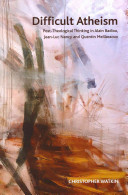
New review of Difficult Atheism at Marx and Philosophy
Over at Marx&Philosophy, Bryan Cooke (whom I had the pleasure of meeting at last year’s Australasian Society for Continental Philosophy conference) has posted a review of Difficult Atheism. The opening paragraph gives a flavour of the review’s tone and also of Bryan’s style, which, for all the right reasons, is best left undescribed: Christopher Watkin’s
-
Difficult Atheism now available on kindle in the US and UK
Difficult Atheism now on kindle in the US and UK (with real page numbers!) For those of a more traditional disposition, the paperback edition is still reassuringly present on amazon.co.uk.
-
Review of Difficult Atheism in The Heythrop Journal
A new review of my Difficult Atheism has just been published in The Heythrop Journal 55:4 (2014): 755-756. Here is the final paragraph, in which the reviewer (Dane Neufeld of Wycliffe College, Toronto) sums up both his commendation of, and reservation about, the book: Difficult Atheism is a challenging read but the difficulty of the
-
Paul Ricoeur and the Autonomy of Philosophy: A Reappraisal
My article “Ricœur and the Autonomy of Philosophy: A Reappraisal” has just been published online in Philosophy Today. Abstract: Paul Ricœur repeatedly maintained that his philosophical reflection was autonomous from theological influence. Those who seek to contest this view have hitherto sought to deny the autonomy of philosophy from theology, but this article makes a
-
Meillassoux, Naturally
On Saturday I will be speaking at the Reconceiving Naturalism conference at Swinburne University, Melbourne. I originally intended to address some aspects of Quentin Meillassoux’s Métaphysique et fiction des mondes hors-science, but with only 15 minutes there isn’t long enough to get into it. Instead, I’ve decided to think through Meillassoux’s critique of naturalism in “Iteration,
-
David Wood on Kinnibalism
I have thought for some time now that the next big rights issue for our society will be fought over the status of animals. Reading a short piece by David Wood this morning entitled Kinnibalism, Cannibalism: Stepping Up to the Plate reminded me just how “locked and loaded” this issue is today. The philosophical justification of the mass killing
-
Reconceiving Naturalism Conference Programme
The programme for “Reconceiving Naturalism: The Speculative Challenge” has just been published. The conference will take place on April 26–27 at Swinburne University, Melbourne, and my paper on Meillassoux is scheduled for the Saturday morning.
-
My review of Hollis Phelps Alain Badiou Between Theology and Anti-Theology published in French Studies
My review of Hollis Phelps’ Alain Badiou: Between Theology and Anti-Theology has just been published in French Studies. It is available in fulltext and PDF.
-
Interview with Amaleena Damlé about her recently published book The Becoming of the Body
Amaleena Damlé’s The Becoming of the Body: Contemporary Women’s Writing in French has just been published in Edinburgh University Press’s Crosscurrents series. In an interview with Amaleena I explored some of the issues raised by the book. CHRIS WATKIN: To paint with very broad brushstrokes as we begin, into which debates is this book
-
Reconceiving Naturalism with Meillassoux’s Métaphysique et fiction des mondes hors-science
Later this month (26-27 April) I have been asked to contribute to a conference organised by Telos at Swinburne University in Melbourne. The conference, Reconceiving Naturalism, has been convened to explore the need for richer naturalisms. I plan to speak on Meillassoux’s Métaphysique et fiction des mondes hors-science. This short volume had a former life
-
Cover and endorsement for Khandker, Philosophy, Animality and the Life Sciences
The cover has just been finalised for Wahida Khandker’s Philosophy, Animality and the Life Sciences, in the Crosscurrents series. The endorsement from Cary Wolfe reads: Ranging across a remarkable array of crucial texts in the recent history of philosophy and the life sciences, this book provides both an invaluable critical overview of the work of
-
Deep Sustainability: Narrative, Religion and Ethics
Drafting the latter chapters of The Human Remains has given me occasion to think in a sustained way about the possibilities and limits of narrative identity, including how the notion can be employed beyond humanity. In addition to revisiting Paul Ricœur’s work on narrative identity I have been grappling with the way in which Michel Serres
-
Catherine Malabou and Synaptic Personhood
On the first of April (yes, really) I’ll be giving a paper at the Deakin University Philosophy seminar series entitled ‘Catherine Malabou and Synaptic Personhood’. The paper argues that the way Malabou seeks to understand the relation between brain and mind as an instance of explosive plasticity, cutting across the dichotomy of reductionism and anti-reductionism, risks
-
Other Logics: Alternatives to Formal Logic in the History of Thought and Contemporary Philosophy
A couple of years ago I had the privilege of speaking at Lund university on the subject of Quentin Meillassoux’s treatment of the anthypothetical principle of logic in L’Inexistence divine and elsewhere. Thanks in large part to the persistent hard work of Admir Skodo, the conference papers have been reworked, expanded, and found their way
-
Question about Freud’s “Psyche ist ausgedehnt” in Derrida and Nancy
In On Touching Derrida makes much of Freud’s posthumous fragment “Psyche ist ausgedehnt; weiss nichts davon”, and the fragment is also treated in Nancy’s Corpus. As far as I can see, the translation is always given as something approximating “Psyche is extended; it knows nothing of it.” My question is this: how do we know
-
Interview with Wahida Khandker about her forthcoming book Philosophy, Animality and the Life Sciences
I am delighted that Crosscurrents will be publishing Wahida Khandker’s new book Philosophy, Animality and the Life Sciences in July 2014. The book is a study of pathological concepts of animal life in Continental philosophy from Bergson to Haraway. Here is the blurb: Amongst contemporary debates about our relation to non-human animals, our use of them
-
Current Research: The Human Remains
I am currently working on a book provisionally entitled The Human Remains: French Philosophy in the Image of God. The first part of the book looks at the ways in which the imago dei motif is explicitly taken up in contemporary French thought. The second, longer part takes debates from the philosophical reception of the
-
De omni re scibili: Kevin Hart
A piece I prepared for a symposium on Kevin Hart at last year’s Australasian Society for Continental Philosophy has just been published in Parrhesia: A Journal of Critical Philosophy. The piece is entitled ‘De omni re scibili‘ and deals in part with a distinction between two contrasting paradigms of interdisciplinarity (in this context, between philosophy and
-
Of ornitheology
How do we decide if a particular philosophy is covertly theological? One all-too-common response to this question boils down to little more than a theological bird-watching expedition in which we don our binoculars, pick up our guide books and descend upon an unsuspecting article or book in the hope of catching sight of a Lesser Spotted Miracle
-
Michel Serres–from Biosemiotics to Econarratology
I’m currently working on Michel Serres’ four books on humanism from 2001-2009, in which he seeks to break down the qualitative distinction between the human and the non-human in a fundamental way. In these books and elsewhere he develops what I think it is best to call an ‘econarratology’, though see the qualification of that
-
La foi chrétienne et les défis du monde contemporain
Editions Excelsis have just published La foi chrétienne et les défis du monde contemporain (The Christian Faith and the Challenges of the Contemporary World), for which I had the privilege to write a 5000 word article on Christianity and relativism, moving through the bible, Augustine, Pascal, Derrida, debates in the French parliament and C. S. Lewis.
-
The Pantasm: Heraclitus, Michel Serres, and the Changeux-Ricœur exchange. On naming the human
The Heraclitean panta In Plato’s Cratylus, Heraclitus is quoted as holding that ‘πάντα χωρεῖ’ (panta chōrei, everything changes), a reality he sees symbolised in the element of fire: All things are an exchange for fire, and fire for all things, as goods for gold and gold for goods. (Heraclitus, Fragment 22 in the Diels-Kranz collection of
-
Dancehouse Diary: When I think, I dance
Last January I had the great pleasure of chatting with Philipa Rothfield about dance and philosophy, and she invited me to contribute something on Jean-Luc Nancy and dance to Dancehouse Diary, a quarterly publication by Dancehouse, the centre for independent dance in Melbourne. The piece, called ‘When I think, I dance’, deals with some of the themes in
-
Difficult Atheism in Paperback
Difficult Atheism is set to be released in paperback this month: £25 or $40, available for pre-order on Amazon.