Derrida
-
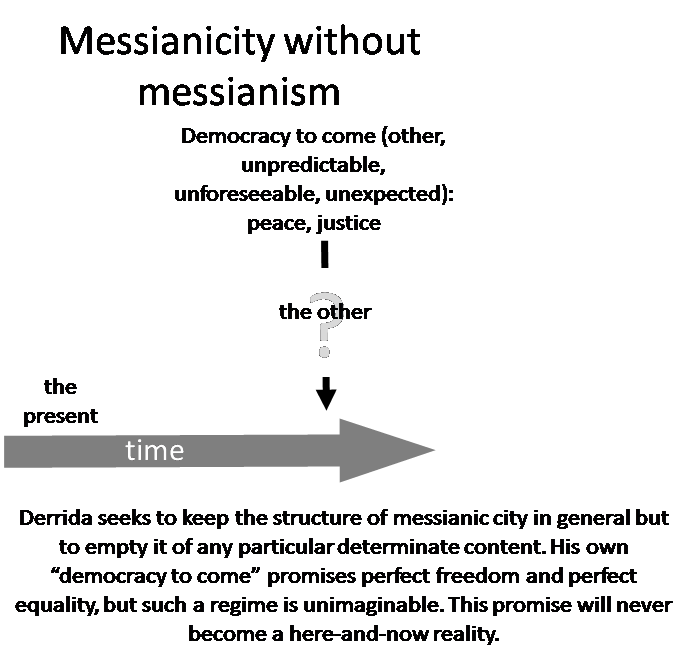
Explaining Derrida with Diagrams 2: Messianicity without messianism
In a previous post I introduced the very idea of Diagramming Derrida before explaining his notion of différance diagrammatically. In this post I set out to tackle the idea of “messianicity without messianism” and, more generally, Derrida’s characteristic motif of “x without x”, for example “religion without religion” or “God without God”. Messianism as Derrida understands it
-

Explaining Derrida with Diagrams 1: Différance
I’ve written a book on Derrida which is intended to be accessible to non-philosophers, and one of the challenges is to explain Derrida’s thought both faithfully and clearly. I have decided to use diagrams as one way of helping readers to grasp what Derrida is saying and, equally importantly, what he isn’t saying. I am
-
Can you help me subtitle my book on Derrida? Describe him in five words or fewer
I have a little book on Derrida coming out later this year, aimed at an advanced undergraduate and postgraduate readership and accessible to non-philosophers. Its aim is to explain Derrida’s thought as clearly and faithfully as possible using diagrams and examples, and then to bring him into conversation with the prologue of John’s gospel in the
-
Third Derrida Podcast: Derrida, Atheism and Theology
The third of the podcasts on Derrida and Reformed theology has now been released. The first considered questions of metaphysics and the second focused on Derrida’s ethics; this final podcast discusses Derrida’s engagement with theological themes. I begin by discussing Derrida’s cautious affirmation that “I rightly pass for an atheist”, and try to dismantle the myth that, for
-
Second in the Derrida and Reformed Theology Podcast series: Derrida’s Ethics
In this episode I talk very briefly about the growing willingness to accept, from the mid 1990s onwards, that deconstruction is indeed ethical, before tackling the myth that Derrida is a relativist. I unpack the phrase “tout autre est tout autre” (“every other is wholly other”) from Derrida’s reading of Kierkegaard on Genesis 22 and
-
Rethinking alterity and logocentrism after phenomenology with Serres’s L’Hermaphrodite: Sarrasine sculpteur (1987)
This post is part of the series of draft entries for a Michel Serres dictionary. Abbreviations: Conv: Serres and Latour, Conversations on Culture, Science and Time TI: Serres, Le Tiers instruit One of Serres’s three book-length engagements with literary authors, l’Hermaphrodite was written significantly later than Jouvences (1974, on Jules Verne) and Feux et signaux