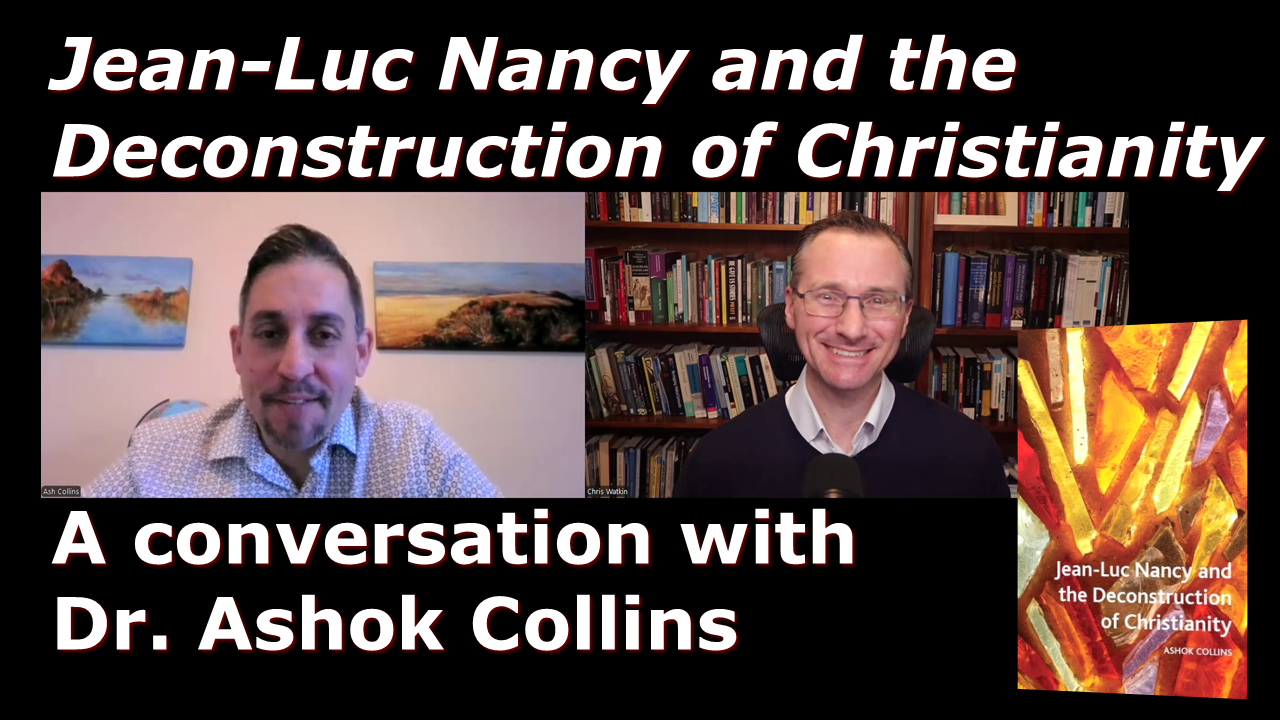
What happens when deconstruction turns toward religion? And what might Christianity look like when read through the philosophical lens of Jean-Luc Nancy?
In this interview I speak with Dr Ashok Collins about his book Jean-Luc Nancy and the Deconstruction of Christianity. Our conversation explores the complex relationship between deconstruction, theology, and contemporary continental philosophy.
You can watch the full interview below.
Deconstruction and the Question of Christianity
The conversation centres on the work of the French philosopher Jean-Luc Nancy, one of the most influential figures in contemporary continental philosophy. Nancy’s work develops themes emerging from the thought of Jacques Derrida and other figures associated with deconstruction, while also forging a distinctive philosophical path of its own.
In a series of texts—most notably Dis-Enclosure: The Deconstruction of Christianity—Nancy argued that Christianity occupies a paradoxical place in the history of Western thought. Rather than standing outside philosophy, Christianity is deeply intertwined with the conceptual and cultural frameworks that shape modern philosophical reflection.
Ashok Collins’ book enters this debate by examining how Nancy develops a “deconstruction of Christianity.” The aim is not simply to critique religion from the outside but to explore how Christian concepts themselves generate new philosophical possibilities.
The “Turn to Religion” in Deconstruction
One of the striking developments in late twentieth-century philosophy has been what many scholars call the “turn to religion.” Thinkers influenced by deconstruction—including figures such as John D. Caputo—have explored how theological themes continue to shape philosophical questions about meaning, ethics, and community.
Collins’ study places Nancy within this broader intellectual landscape. His book argues that Nancy’s thought opens a distinctive path within deconstructive philosophy—one that radicalises the logic of différance while rethinking Christianity as a dynamic philosophical resource rather than a static doctrinal system.
Christianity, Philosophy, and Figuration
A key idea in Collins’ interpretation is figuration. Rather than treating philosophical ideas as purely abstract concepts, Nancy often develops them through images, figures, and literary forms.
This figurative approach allows Nancy to rethink the meaning of Christianity in philosophical terms. Instead of asking whether Christianity is true or false in a doctrinal sense, he asks how its conceptual structures—ideas such as incarnation, community, and revelation—continue to shape modern philosophical reflection.
Collins’ book traces these themes through a careful reading of Nancy’s work and its dialogue with both philosophy and theology.
Why Nancy Still Matters
The questions raised by Nancy’s philosophy remain deeply relevant today. Debates about secularisation, post-secular thought, and the relationship between religion and public life continue to animate contemporary intellectual culture.
Nancy’s work suggests that Christianity cannot simply be left behind as a relic of the past. Instead, it remains embedded within the conceptual structures through which modern societies understand community, meaning, and the shared world.
For this reason, Nancy’s philosophy continues to provoke important discussions across philosophy, theology, and cultural theory.
Watch the Interview
If you are interested in contemporary French philosophy, deconstruction, or the complex relationship between Christianity and modern thought, I hope you enjoy this conversation with Ashok Collins.
The full interview is available above.
Leave a Reply